What this is: the implementation guide for the voice arc of my family voice kiosk. I replaced the kiosk’s generic TTS voice with a voice clone of Reach Cortana, trained on 213 clean voice lines extracted from my own legally-owned copy of Halo: The Master Chief Collection. The shipped path has four parts: extracting and vetting the corpus from the game’s audio banks, an F5-TTS false start that taught the data lessons, an OmniVoice zero-shot spike that proved the direction, and a LoRA finetune merged into a standalone model that now answers every question the kiosk gets. This guide is the companion to the kiosk guide: I Built My Family a Voice Assistant That Never Touches the Cloud.
What is deliberately out of scope: RVC timbre training. It was tried first, it sounded right on single samples and wrong on whole answers, and the OmniVoice switch replaced it as the voice. A trained RVC model still sits in the kiosk’s fallback path as a timbre layer on Kokoro, but training one is no longer required to recreate this system: skip it and the fallback is plain Kokoro. This guide covers the path that shipped.
Environment used here: Windows 11, two RTX 5060 Ti 16 GB cards, Python 3.11 and 3.12 venvs, CUDA 12.8. Training ran on one 5060 Ti.
What you need first: a legally-owned copy of Halo: The Master Chief Collection installed on the machine you decode from, an NVIDIA GPU you can finetune on, and the kiosk guide’s server if you want the voice to end up somewhere. The corpus has to be yours, so read the boundary note below before you spend a day on this.
Verified here: the figures below come off this setup as it stood on 2026-09-07. Nothing is from a spec sheet. The kiosk server source and auth module are published with the kiosk guide’s manifest; the lab log, the training data, and the model stay on the box (section 8).
Boundary first: the source audio is my own MCC install, the training corpus never left the machine, and the finished voice is a local model that serves my LAN only. The OmniVoice code is Apache-2.0; the model weights are CC-BY-NC (trained on Emilia), which private non-commercial family use complies with. That does not automatically carry to a public demo or a work showcase. If you cannot say the same about your source material and your use, this pipeline is not for you.
Fan project notice: this is an unofficial fan project. It is not affiliated with, sponsored by, or endorsed by Microsoft, 343 Industries, or the Halo franchise. No game assets, voice clips, or cloned-voice samples are redistributed on this site; the measurements and the code are all that is published.
Follow it top to bottom, or hand it to an AI agent to run the mechanical phases (section 10).
0. Goal and acceptance
The goal: the family kiosk stops sounding like a generic TTS voice and starts sounding like her. The target is a delivery that holds up word for word across whole answers.
Acceptance criteria, all met on 2026-09-07:
| # | Criterion | Measured |
|---|---|---|
| 1 | Corpus with provenance, not scraped audio | 213 lines, ~5.3 min, every file SHA-256-matched to my own game decode |
| 2 | Female-verified source | 192 of 213 at or above 180 Hz; 21 low-register files verified female by formant profile and voicing retention |
| 3 | A voice with her delivery, not just her timbre | OmniVoice zero-shot from 3 reference lines (9.7 s); verdict: “night and day improvement” |
| 4 | The finetune bakes the corpus in | LoRA r16/a32, 250 steps (~5 epochs), final loss 2.75, ~2 min on one 5060 Ti |
| 5 | Runtime model is standalone | merged model 3.1 GB, no PEFT dependency at runtime |
| 6 | Quality control on real output | whisper word-for-word on test lines; sample median F0 199, 218, 254 Hz (inside her verified range) |
| 7 | Live in the kiosk with a fallback | e2e PASS on every voice stage; automatic fallback chain behind the clone |
| 8 | Nothing from YouTube, nothing redistributed | YouTube audio banned as a source after a contamination catch; output is a local model |
Time: one day (2026-09-07). Cost: zero new hardware; compute is a spare GPU afternoon.
1. The corpus: from a Steam folder to 213 clean lines
The whole build stands or falls on source audio. Getting clean, verified, female, on-voice audio is a pipeline with its own traps; this is the one that worked.
1.1 Find the audio and learn what it is
The game install was at the usual Steam location, and Reach’s dialogue is not in loose files: it is in an FMOD bank.
...\Steam\steamapps\common\Halo The Master Chief Collection\
    haloreach\fmod\pc\english.fsb        (380 MB, all English voice)
    haloreach\fmod\pc\english.fsb.info   (8.8 MB binary name table)
The .fsb magic identifies the format: FSB5, FMOD’s bank format, with a
header of magic, version, sample count, header size, and data size. One
number in that header is the whole key to the project: 31,433 samples. The
.info file next to it has exactly 31,433 names. Index i in the name
table is sample i in the bank, so every one of the 31,433 streams has a
real path name like data\sound\dialog\combat\cortana\default\... instead
of being an anonymous stream in a 380 MB blob. Parse the name table once
and you can search the dialogue like a filesystem.
1.2 Decode the bank
The decoder is vgmstream, the standard tool for game audio. The r2117
build used here ships from the project’s release page
(github.com/vgmstream/vgmstream/releases), and the FSB5 container layout
plus the -s subsong rule are documented in its doc/FORMATS.md.
vgmstream-cli -o out.wav -s N file.fsb
-s N selects sample N (1-based); without it you get the first subsong
only. The name table is an index-ordered list of dialogue paths, so the driver
script is one pass: read entry i, then decode sample i with -s and
write it out under {index}_{slug}.aif.wav. Keeping the index and the name
together inside that single loop is what makes the map trustworthy at
section 1.4, where the hash gate re-derives the same index. The result for
the Cortana subset was 588 of 588 samples decoded cleanly: 15.0 minutes of 48 kHz mono, archived under
{index}_{slug}.aif.wav names in a raw-decode folder. The double extension
bit me later (section 3); ignore it for now.
1.3 Find who is speaking: the path map and its three lies
Every decoded stream carries its dialogue path. Paths are speaker maps, and this is where the first contamination happened. Three traps, each one real:
dialog\firefight\cla_cov_*is Covenant dialogue, not Cortana.dialog\firefight\cla_unsc_*is the UNSC firefight ANNOUNCER: a male voice at 95 to 148 Hz. It sits in the firefight announcer slot where Cortana also speaks in the fiction, it sounds announcer-adjacent, and samples like “Mission Aborted” sit at 95 Hz. This batch was in the first training corpus as roughly 20 percent of the data before I caught it by ear and the pitch gate confirmed it.dialog\combat\cortana\default\11_involuntaryis her grunts. Grunts are not speech; exclude them.
The real Cortana corpus lives in paths that literally say so:
dialog\combat\cortana\default\* (02_combat kill quips, 03_postcombat
praise, including “Don’t make a girl a promise…” and “If I had fingers,
they’d be crossed”), plus firefight_preview_dialog\cortana and
dialog\levels\m80 (campaign). The final whitelist is those three path
families and nothing else.
Then every one of the 588 decoded samples was transcribed with the
whisper CLI on CPU, JSON output, into a JSON file of file, duration, and
text. The run costs about 2 minutes on this box for the whole set, so
transcribe all of it rather than guessing which samples matter. The point
of the pass is that the corpus could be searched by what she actually says. That is
how the calm reference lines were found later: not by listening to hours
of audio, but by searching transcripts for conversational content.
1.4 The gates that keep a corpus honest
After the male-announcer catch, every file in the corpus had to pass four gates before it counted:
- Provenance, by hash. SHA-256 of the file must match its own decode from the game bank. No other source exists. Zero violations.
- Path whitelist. The dialogue path must be inside the three Cortana families. Zero violations.
- Pitch. Median F0 at or above 170 Hz (librosa
pyin) is the female gate, a threshold I set from this corpus after the announcer catch. 192 of the 213 files sit at 180 Hz or above, clear of it. - Formant and voicing, for the low register. The remaining 21 files run from 149 to 182 Hz, mostly deadpan delivery, and pitch alone is too close to the line to trust. The tiebreaker is a formant profile (F2/F3 matching the female references, not the male 96 to 148 Hz announcer references) plus a floor-120 voicing-retention test: on this corpus female speech keeps 50 to 81 percent voiced frames at that floor, male speech collapses to 16 to 24 percent.
One measurement is a trap by itself: median F2 is not a sex test, because it tracks vowel content. It flagged eight false positives on its own, including “low on ammo” with its /oʊ/ vowel. The verdict after all four gates: 0 male voices in 213 files, ~5.3 minutes of audio.
1.5 Why the corpus is small on purpose
5.3 minutes is small by commercial TTS standards and large enough to matter, because every second passed four gates. The earlier attempts were bigger and dirtier (the announcer batch alone added 20 percent of audio that had to be thrown away). A bigger pile of dirty audio trains worse than a small pile of verified audio, and a finetune this small is cheap enough to redo, so the gate cost is one-time and the corpus stays honest.
2. The engine search: F5-TTS first, OmniVoice second
The first zero-shot engine was not OmniVoice. It was F5-TTS, and it failed in instructive ways before OmniVoice made the cut.
2.1 F5-TTS: the false start that taught the data lessons
F5-TTS ran in its own venv on the same box, and it cost a morning of
Windows-specific pain that is worth one paragraph: torchcodec needs a
matching FFmpeg shared build (torchcodec==0.11.1+cpu plus FFmpeg 8.1.1
shared DLLs, because the current gyan.dev builds ship avcodec-63, which
torchcodec does not support), and scripts must call os.add_dll_directory
before importing f5_tts. The output of infer() is a numpy array, not a
file. In this build zero-shot needs an explicit ref_text: the auto-ASR path
returned None, so reference lines were transcribed with Whisper first.
The samples told the real story, and my ear was the QC:
| Sample | Reference source | Verdict |
|---|---|---|
| f5_h3 | Halo 3 Cortana voice-bank rip (YouTube) | not favored |
| f5_reach | Reach firefight lines (YouTube-era rip) | most accurate timbre, but combat-urgent delivery, wrong for conversation |
| f5_reachcalm | Reach ending cutscene (YouTube) | “nothing like Cortana” |
The cutscene lesson is the durable one: mixed cutscene audio, with a music bed under the voice, breathy emotional delivery, and compression, makes a zero-shot clone drift to a generic voice. Clean dry game audio clones well; mixed cutscene audio does not. And one reference file from this era carried a non-game preamble, “good morning here is my voice reading a sample for you to compare”, caught by whisper transcription later. File names lie; transcriptions do not. That preamble explains a lot of the weak F5 cloning in hindsight.
2.2 OmniVoice zero-shot: the spike that shipped
OmniVoice (k2-fsa/OmniVoice) is a 0.6B model on a Qwen3-0.6B backbone: code Apache-2.0, weights CC-BY-NC (trained on Emilia), which private non-commercial family use complies with. The zero-shot API is two calls:
model.generate(text, ref_audio, ref_text)          # -> numpy int16 @ 24 kHz
create_voice_clone_prompt(ref_audio, ref_text)     # -> encode once, save/load .pt
The second call is the kiosk-shaped one: the reference is encoded once into a prompt file at build time and loaded at boot, so no answer ever pays reference work. The reference was three calm lines built from the corpus by the selection script (9.7 s total), transcribed and whisper verified.
Measured on the spike, one 5060 Ti, fp16:
| Number | Value |
|---|---|
| Model load | 108 s (includes a 13-file download to the shared HF cache) |
| Warm realtime factor | ~0.24: 5.9 s of audio synthesized in 1.4 s |
| First call | ~1.0 RTF (warmup), then fast |
| A/B sentence, same text as the RVC sample | whisper word-for-word, median F0 235 Hz (p5 155 / p95 294) |
| Personality line | whisper word-for-word, median F0 187 Hz (p5 149) |
The personality line from that spike, pre-finetune. The audio itself is not published (section 8), so here it is as a spectrogram:
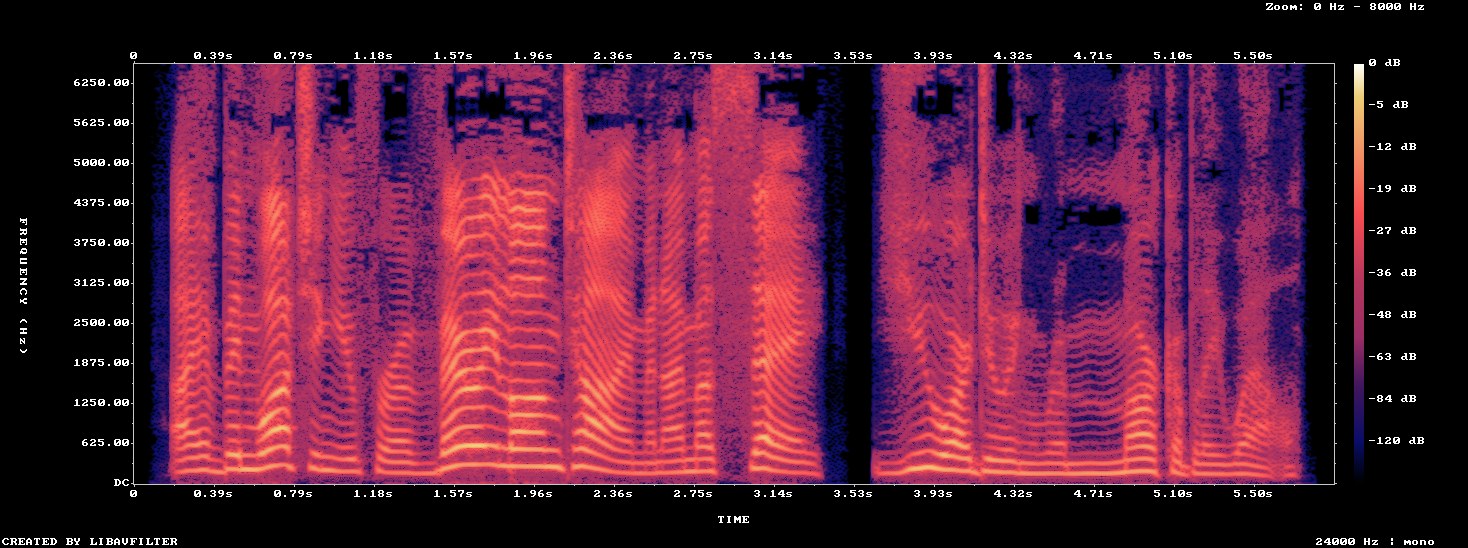
0 to 8 kHz, log scale, 5.9 s: the line the QC table measures.
The first sample was a clear improvement over everything before it, and OmniVoice became the primary voice immediately. Zero-shot was good enough to ship. The finetune in section 3 exists because zero-shot still leans on the reference at generation time, and because a finetuned model needs no reference audio at generation time, ships as one merged file, and produces identical output every time.
3. The finetune: 213 lines into a standalone model
The corpus was finetuned into the model with a LoRA adapter. The data format is one JSONL per line of audio, the schema straight from the finetune examples, and the first two lines of the training file on the box read:
{"id": "0001_29755_morefoe_2", "audio_path": "...ft_audio\\0001_29755_morefoe_2.wav", "text": "Warning, more covenant on approach.", "language_id": "en"}
{"id": "0002_29756_morefoe_3", "audio_path": "...ft_audio\\0002_29756_morefoe_3.wav", "text": "Blast! There's more of them!", "language_id": "en"}
The pipeline, in order:
- Build the JSONLs from the transcribed corpus (197 train / 16 dev
lines), with the audio paths re-pointed into the finetune audio folder.
A small helper fixes the legacy double-extension ids: webdataset splits
tar member names at the FIRST dot, so
.aif.wavids silently break the reader. Single-extension ids only. - Tokenize to shards: audio runs through the higgs-audio-v2 tokenizer
into WebDataset shards (33 train, 16 dev). On Windows this step needs
--loader_workers 0: 24 workers exhausts the paging file (WinError 1455). And webdataset operations needfile://prefixed paths, because aC:/path is parsed as a URL scheme; plain paths stay plain foropen()and existence checks. - Train: the shipped configuration, all measured:
| Item | Value |
|---|---|
| Adapter | LoRA rank 16, alpha 32, dropout 0.1 |
| Optimizer | lr 1e-4, warmup ratio 0.01, bf16 |
| Attention | SDPA (the non-flex-GPU config path) |
| Batch | 2048 tokens, num_workers 0, prefetch_factor None |
| Run | 250 steps (~5 epochs), about 2 it/s on one RTX 5060 Ti |
| Final loss | 2.75 |
| Wall time | about 2 minutes |
| Output | adapter checkpoint at step 250, 107 MB |
- Merge: the adapter merges into a standalone model, 3.1 GB total, no PEFT dependency at runtime. Merge after train, test the merged file, ship the merged file: the sidecar is one model file and one inference path, and the voice cannot break because an adapter failed to load.
Note (batch size is a memory decision, not a quality one): the trainer
OOMs on length-grouped padding at batch 64. Set max_batch_size 4 to 8 with
num_workers 0 and prefetch_factor None. expandable_segments is a
Windows no-op, so it will not save you. Decide the batch from the card you
have, then leave it alone.
Note (keep the Windows run short): random epoch resets and saves crash with 0xC0000005, and a crash mid-save leaves an empty checkpoint directory that cannot resume. That is why the table above says 250 steps with a single end-save. A relaunch costs about 2 minutes, so there is no reason to carry the risk of a long run.
Note (install the right OmniVoice): PyPI omnivoice 0.2.1 has no LoRA
support. The LoRA config is silently ignored and the run escalates to a
full finetune that OOMs. Install the GitHub master build with
--force-reinstall --no-deps or the LoRA path does not exist.
Note (the finetune invalidates the zero-shot prompt): the finetune
retrains the audio embeddings, so the zero-shot cortana_prompt.pt from
section 2 is incompatible with the finetuned model. The kiosk sidecar
rebuilds the clone prompt at boot from the finetuned model instead. If you
skip that step, the sidecar fails health checks with a prompt mismatch
that looks like a model-load bug.
250 steps for 5.3 minutes of audio was proportionate: enough passes for the model to internalize the delivery, few enough that the run finished before the Windows paging failures in section 6 could kill a checkpoint. Longer is a knob; measured cost is about 2 minutes per 250-step run.
4. Quality control: transcription and pitch, not ears alone
A voice clone is easy to fool yourself about. The QC battery the finetuned model had to pass:
| Check | Method | Result |
|---|---|---|
| Wording | whisper word-for-word transcription of every test line | clean |
| Pitch | median F0 on three samples | 199, 218, and 254 Hz |
| Range | all samples inside the verified corpus range | yes |
| Ear test | the line “Don’t make a girl a promise” (in the training set) | delivered clean |
Two QC layers, one objective (transcription, pitch) and one subjective (the ear test). The objective layer catches model collapse and mispronunciation; the ear test catches the uncanny valley that numbers cannot. Sample deliverables from both the zero-shot and finetuned models were saved as audio files on the box for exactly this: side-by-side listening decided the swaps. They stay on the box.
The finished thing, 37 seconds: the tablet kiosk answering, recorded off the screen. That is the ear test the numbers cannot express. The recording is not published: it carries the kiosk screen and the clone speaking, and neither belongs on a public page. What stands in for it here is the measurement half: the spectrogram in section 2 and the transcription and pitch rows in the QC table above.
5. Into the kiosk: one sidecar, one port, automatic fallback
The clone does not live inside the kiosk server. It runs as a separate
process, kiosk_omni_sidecar.py, that the server spawns and calls over
HTTP, so a crash in the voice model can never take the kiosk down, and the
clone owns a whole GPU so a long answer cannot starve speech to text or
the brain. The integration contract, quoted from the published server
source:
| Fact | Value |
|---|---|
| Port | 18083 (health and synthesis) |
| GPU | 0, forced at spawn with CUDA_VISIBLE_DEVICES=0 in the child environment |
| Health | GET /health returns JSON with a ready boolean |
| Synthesis | POST /synth with {"text": ..., "speed": 1.35} returns raw int16 PCM at 24 kHz |
| Boot | server polls health up to 90 s after spawn; ready marker: [omni] sidecar ready (OmniVoice Cortana live) |
| Prompt | rebuilt at boot from the merged finetuned model (the zero-shot prompt is incompatible, section 3) |
| Failure | a failed call trips a 180 s circuit breaker, then re-probes; the answer falls to Kokoro in the meantime |
| Fallback | per sentence piece, automatic: OmniVoice, then Kokoro with RVC timbre, then pure Kokoro |
The server passes its own PID to the sidecar at spawn
([python, sidecar.py, str(os.getpid())]): the sidecar monitors its
parent and exits when the kiosk goes down, so a tear-down leaves no orphan
holding GPU0 VRAM.
Measured after the finetune went live: GPU0 at 5.4 of 16 GB with the merged model, against 2.7 GB for zero-shot, though the two figures are not the same workload (the merged file carries the finetuned embeddings; the zero-shot path held a reference prompt as well), sentence pieces 1.5 to 7.9 s of audio, 1.2 to 1.5 s generation per piece, e2e PASS.
The piece-splitting rule that fixed cut-out speech. OmniVoice generation costs about one second fixed per call regardless of piece size. Comma-level fragments, about one second of audio each, could not keep the gapless player fed, and the symptom was intermittent speech cutting out. The server splits on sentence boundaries instead, into pieces of 1.5 to 8 s of audio, keeping the client queue two or more pieces ahead; a 200 character ceiling falls back to comma granularity so a never-ending sentence still streams. Speech rate is 1.35, matching the Kokoro cadence the family already liked, so the clone and the fallback voice do not sound like different speeds to the same question.
6. Avoid My Mistakes
- PyPI omnivoice 0.2.1 has no LoRA support. The config is silently ignored
and the run escalates into a full finetune that OOMs. Install GitHub
master with
--force-reinstall --no-deps. - Tokenization workers on Windows exhaust paging.
--loader_workers 0. Twenty-four workers earned a WinError 1455. - webdataset on Windows rejects drive letters.
C:/paths are parsed as a URL scheme by gopen. Usefile://prefixes for webdataset operations and plain paths foropen()and existence checks. - Tar member names split at the first dot. Corpus ids must be
single-extension; legacy
.aif.wavnames broke the reader silently. - The trainer OOMs on length-grouped padding at batch 64. Use
max_batch_size4 to 8,num_workers0,prefetch_factorNone.expandable_segmentsis a Windows no-op, do not rely on it. - Windows crashes at random epoch resets and saves (0xC0000005), and a mid-save crash leaves an empty checkpoint directory that cannot resume. Run short (250 steps) with a single end-save. Relaunch is cheap.
- Speaker maps lie twice.
cla_cov_*is Covenant, andcla_unsc_*, the firefight announcer slot, is a MALE voice at 95 to 148 Hz that spent hours in the corpus as “Cortana”. The folder that says cortana is her; thecla_unsc_*folder is not. Gate on pitch after you map by path. - Verify by content, not by name. A 16-file male batch passed the name check and failed the pitch gate. A reference file carried a non-game preamble that whisper transcription caught after approval. Gate everything on measured content, verify after approval, and ban YouTube audio outright: mixed cutscene audio drifts a zero-shot clone to a generic voice.
- An unmerged adapter is a runtime dependency you do not want. The kiosk loads one merged 3.1 GB model with no PEFT layer. Merge, test the merged file, ship the merged file.
- Judge with your ears, then with numbers. The timbre-only approach passed single-sample listening and failed whole-answer prosody. The OmniVoice spike passed both. Transcription and pitch QC catch what listening misses, and listening catches what numbers cannot express.
- A finetune that retrains embeddings invalidates the zero-shot prompt. Rebuild the clone prompt from the finetuned model or the sidecar dies on a mismatch that looks like a load bug.
7. Day-2 operations
- Verify alive:
netstat -ano | findstr ":18083"LISTEN, then check the kiosk log for the clone ready line, then run the kiosk e2e from the kiosk guide’s manifest. - Sidecar log:
omni_sidecar.lognext to the sidecar script. - The kiosk server boots the sidecar at startup and the sidecar exits with its parent, so bring-up and tear-down are just the kiosk’s own restore and stop files (kiosk guide, section 11).
- Want more of her: the knob is steps. Measured cost: about 2 minutes per 250-step run on one 5060 Ti, plus a merge and a prompt rebuild.
- Samples: the zero-shot and finetuned deliverables are kept as audio files for side-by-side QC on every future voice change.
8. What stays on the box
The lab log, the finetune JSONLs, and the trained model stay on the box:
this is a private project and nothing about the corpus or the clone is
published anywhere: no audio samples, no demo recordings, only the
measurements above. The measured configuration in sections 3 and 5 is complete for the run
itself: the training config, the four corpus gates, the merge rule, and the
sidecar contract are all above. It is not a command-level rebuild on its
own, and saying so plainly beats letting you find out at step two. What the
post does not ship: the sidecar scripts (kiosk_omni_sidecar.py,
kiosk_rvc_sidecar.py), the helpers that walk the bank and pick the corpus
(parse_info, decode, montage, survey, select_build), and the tokenize and
train shell scripts. Those stay on the box. Each is a small script wrapped
around a command line that section 1, 3, or 5 already shows, so an agent can
write it from this page. The kiosk’s own code (server, auth, tests,
clients) is published with the kiosk guide’s manifest, so the integration
contract is executable as written.
9. Threat model
What this machine is: a local HTTP sidecar that loads a voice model onto a whole GPU, spawned and owned by the kiosk server, plus a training pipeline that installs a Python package from the engine’s GitHub master branch. That combination is worth an honest paragraph before you copy it.
What the guardrails stop. The sidecar has no shell and no network egress; it takes text and returns audio. It is spawned by the kiosk server with the parent PID and exits when the parent does, so a tear-down leaves no orphan holding the card. The source boundary does the heavy lifting for the legal side: the corpus never leaves the machine and nothing is redistributed, which is why the fan notice at the top is short and true.
What they cannot stop. Be clear about all four. The install command
--force-reinstall --no-deps runs unreviewed code at your user’s privilege
and skips dependency resolution by design, so pin a commit and read the diff
if that matters to you. POST /synth accepts free text and costs GPU time,
so anyone who can reach the port can drive your card and get audio in your
clone’s voice; the port belongs on a trusted LAN and never in a forward.
The text the sidecar speaks is written by the kiosk’s brain, and that brain
reads search results and web pages, so fetched text is the injection path:
a cloned voice reading back an attacker’s sentence is the failure mode that
matters here. And the license is yours, not the code’s: non-commercial
weights stay non-commercial whatever you build around them.
Minimum hardening. Run the sidecar as a dedicated non-admin user that owns nothing else. Bind it to the interface the kiosk uses and leave it unreachable from anywhere else. Never give the sidecar a command interface, even a debugging one. Keep the lab log, the corpus, and the merged model on local disk rather than a share. If the kiosk’s brain has network tools, treat everything it produces as text from an untrusted source, because that is what it is.
10. Hand it to an agent
This guide is structured so an AI agent can execute the mechanical phases it can see: decoding, transcription, selection against the whitelist and the pitch gate, training from the config table, merging, and the QC battery. The bank walk, the tokenize step, and the train scripts are box-only (section 8), so budget an agent an afternoon to write those three around the command lines above rather than an hour to run them. Keep yourself in the approval path at four gates: source acquisition (your install, your license), the training run, the merge, and any change to the kiosk voice chain. Tell the agent the source boundary in the same sentence as the task: no scraped audio, no YouTube, nothing redistributed, model weights under CC-BY-NC mean non-commercial only. A voice trained on audio you do not own is a problem no flag can fix later.